
TxLege Analysis: Democrats vs Republicans
What each party posts about, what gets engagement, and the candidates driving the conversation.
This is part two of our three-part series looking at the online conversation around the Texas midterms. If you missed last week’s analysis, you can view it here.
In part two of our 2026 TxLege Candidate Analysis, we take a look at how the online conversation around Texas candidates and the 2026 Midterms differs by political party. Our analysis found that key differences exist between the number of posts, post engagement (spoiler alert: number of posts and level of engagement are not always aligned), and the topics candidates lean on the most to make their case to Texas voters. The data show a real distinction between what Republican and Democratic candidates view as the most important issues to their online audience—and how their messages are landing.
Republicans posted 34% more than Democrats from the beginning of 2026 through the end of September (87,895 posts to 65,820). But Democrats have received more engagement – despite significantly fewer posts, Democrats still outperformed Republicans with raw engagement numbers 77.3M - 74.7M.
This translates to an average of 849 engagements per post on the Republican side and 1,174 engagements per post on the Democratic side. Most of this is thanks to James Talarico, who received 7.7x more engagement than Ken Paxton and represents the lion’s share of Democratic candidates’ engagement overall (53.9M of 77.3M).
Will this social media enthusiasm translate to more votes? We’ll know in less than two weeks. Until then, we have some interesting insights about which topics are breaking through, who the public engages with from each side, and the difference in approach from each party.
Key takeaways
Republicans posted more. Democrats got more engagement. Republicans posted 34% more than Democrats, but Democrats received 38% more engagement per post (raw numbers: 1,174 per post for Democrats, 849 per post for Republicans).
James Talarico and Brandon Gill drove engagement for their respective parties. James Talarico’s posts received 53.9M engagements across platforms and significantly outperformed Ken Paxton’s (7M). Congressman Brandon Gill led Republicans with 40.6M engagements.
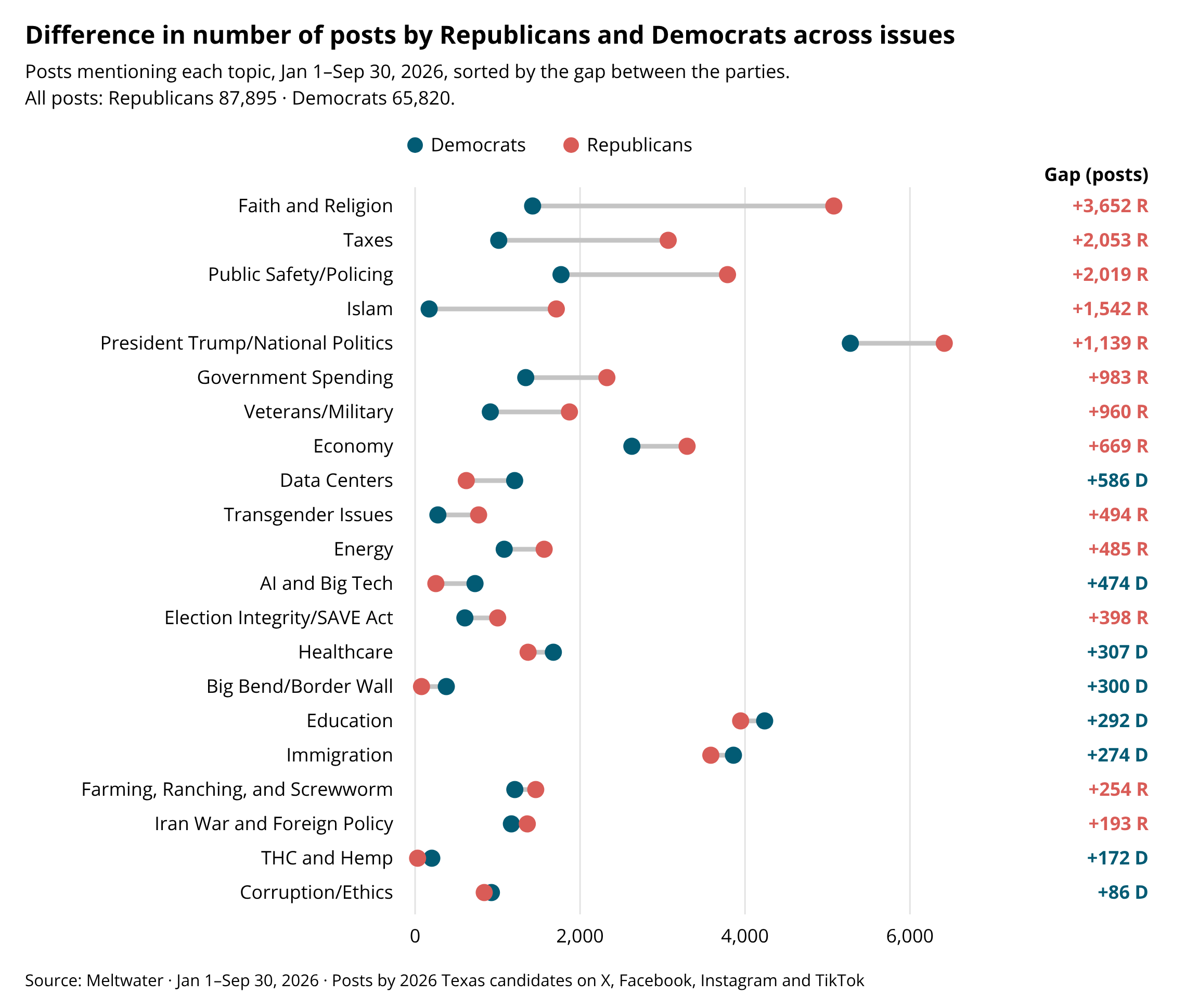
Party lanes: Republicans posted 7.5x more than Democrats on Islamic related issues, and also posted more on faith, taxes, transgender issues, and election integrity. Democrats posted more on THC, the Big Bend border wall, AI, data centers, and healthcare.
Immigration drove Republican engagement. It's only the party's fifth most discussed topic, but it drew more Republican engagement than any other.
President Trump/National Politics drove Democratic candidate engagement. Posts about the president drew 15% of all Democratic candidate engagement, compared with 9% for Republicans.
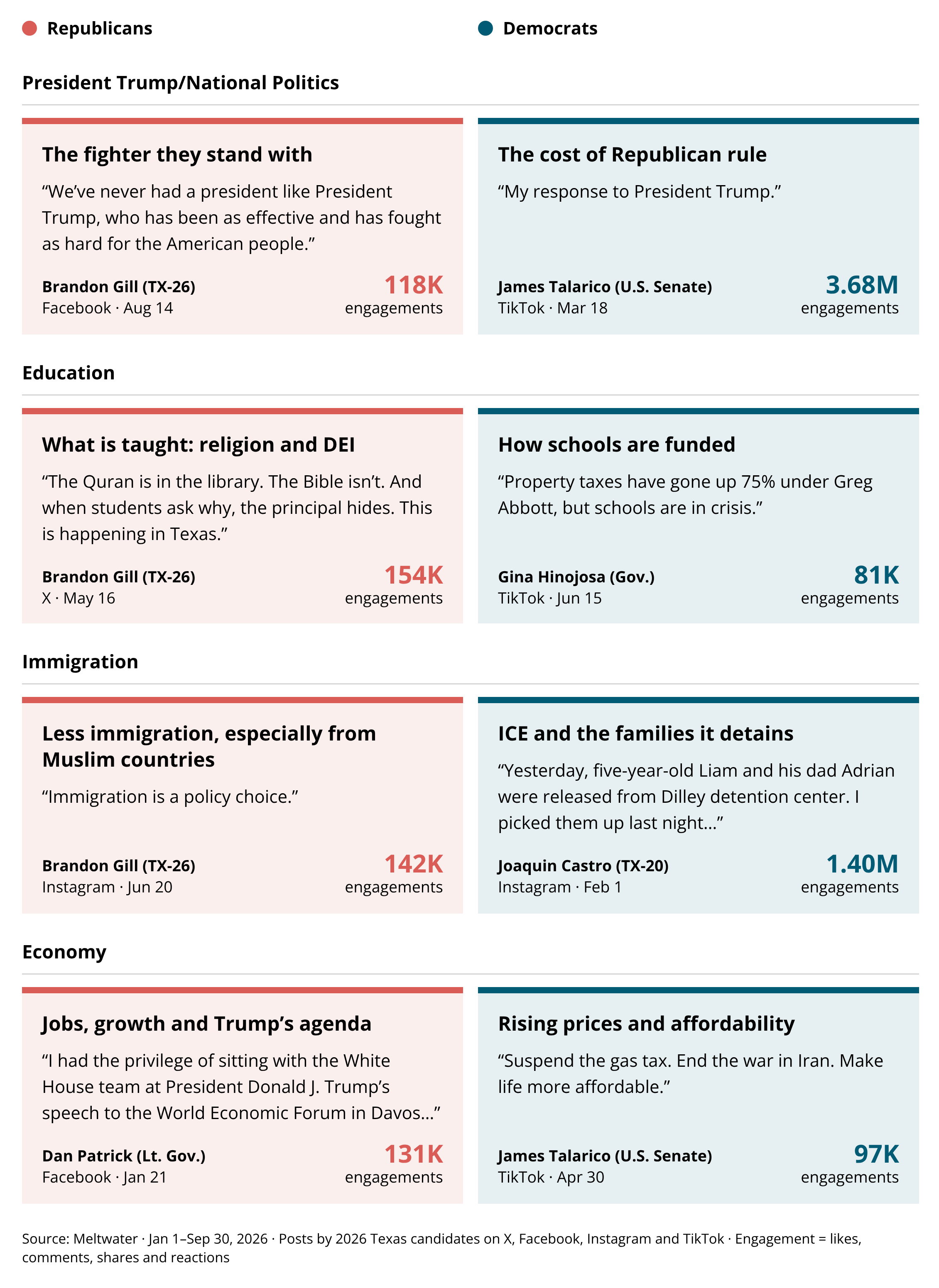
Same topics, varying stories. Both parties posted frequently about President Trump, schools, immigration, and the economy, but they described different problems.
-
Data Source: Meltwater
Dates: Jan. 1 – Sept. 30, 2026
Posts: every post, repost and quote post from a candidate’s account on X, Facebook, Instagram or TikTok, including personal, official, and campaign accounts.
Candidates: 2026 candidates for statewide office, U.S. Congress, and the Texas House and Senate (408 tracked; 296 posted)
Engagement:
Facebook: reactions (including likes), comments and shares
Instagram: likes and comments
X: likes, replies, reposts and quote posts
TikTok: likes, comments and shares
Character limit: Our social listening tool captures only the first ~145 characters of each post, and more than half of posts hit that limit. Topics are tagged from that text, anything mentioned later in a long caption, or only in a video or image, is missed.
Reposts: Reposts count toward post totals but carry no engagement of their own. About 30% of candidate posts on X are reposts.
Republicans and Democrats are running on different issues
Republicans posted 34% more than Democrats overall, with the widest gap in post volume on issues of faith, taxes, public safety, and Islam. Democrats posted more than Republicans on data centers, AI, schools, immigration, healthcare, and the Big Bend border wall. Posts on corruption were nearly equally distributed across party lines.
When they do post about the same issues, they drive different narratives
Republican candidates largely defended current leadership and policy, while Democratic candidate framing tended to focus on the personal impact of Republican policies.
What & who drive Republican engagement
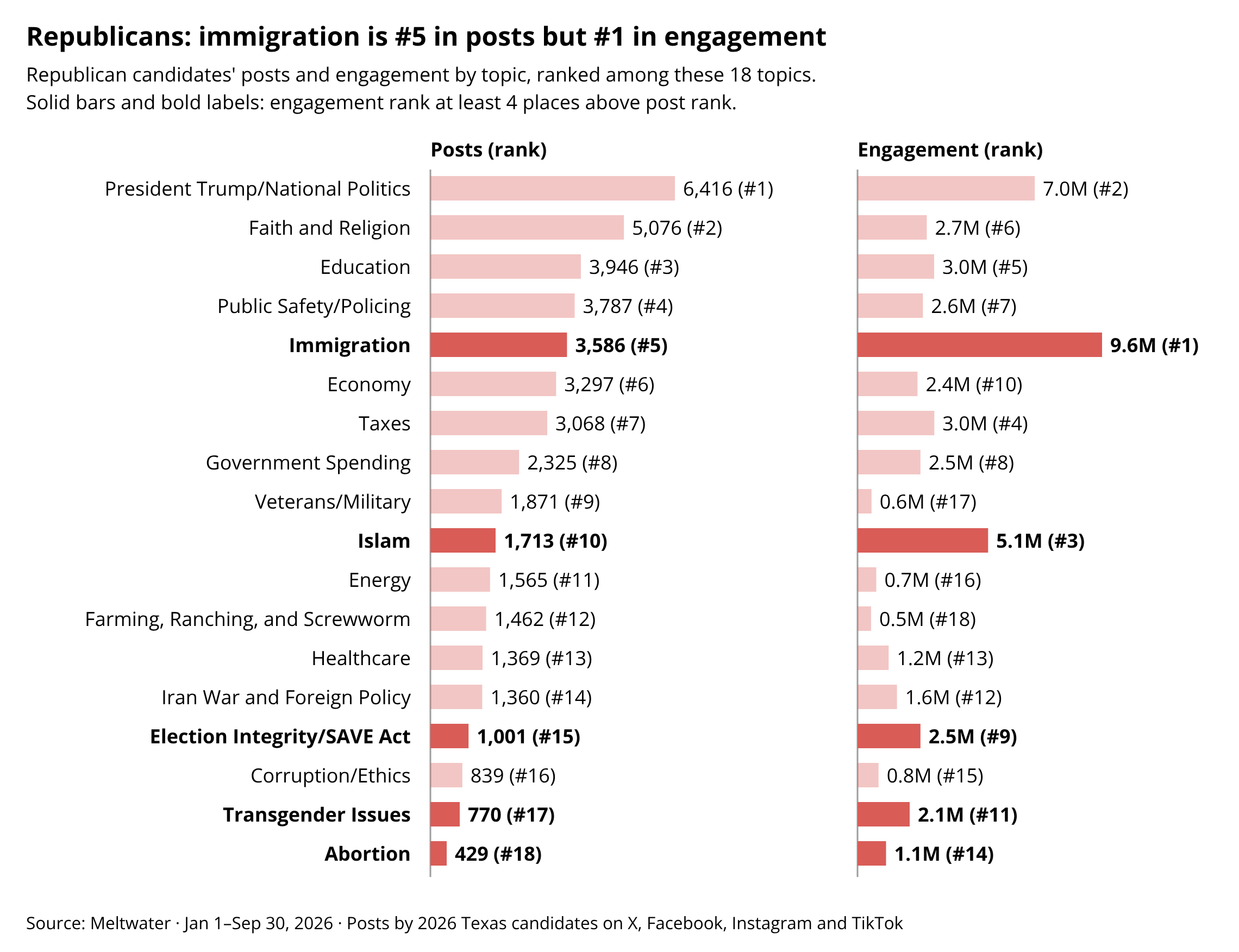
Each party saw significant engagement across multiple topics. Immigration was only the fifth-most-posted Republican topic, but it drew more Republican engagement than any other topic (9.6M). Islam, election integrity, transgender issues, and abortion also ranked far above their post counts on engagement.
Each party saw significant engagement across multiple topics. Immigration was only the fifth-most-posted Republican topic, but it drew more Republican engagement than any other topic (9.6M). Islam, election integrity, transgender issues, and abortion also ranked far above their post counts on engagement.
Republican leaderboard
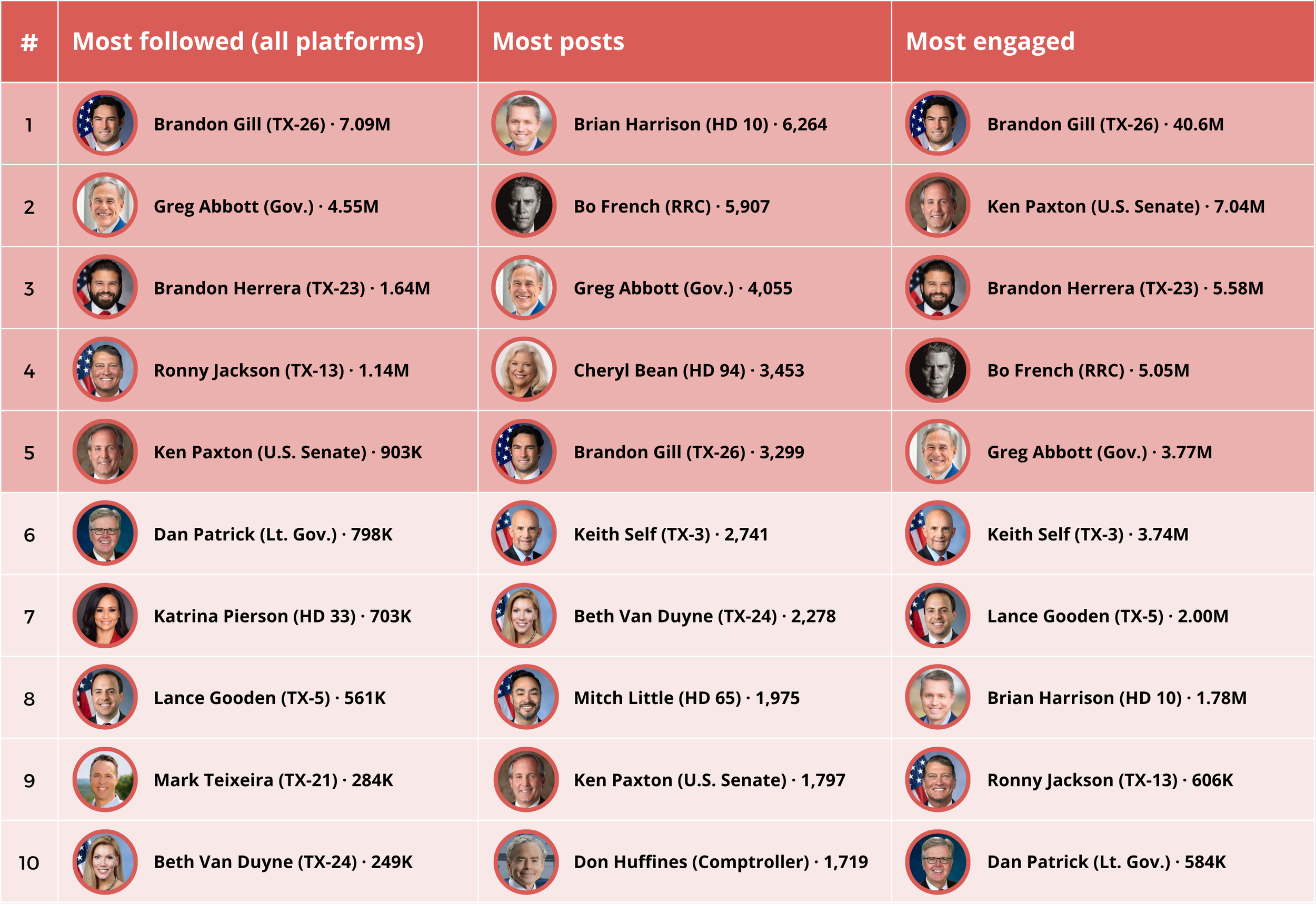
Brandon Gill led other Republicans by far on following and engagement. Greg Abbott has the second-highest following and led the remaining Republicans by a significant margin, but he trailed Ken Paxton, Brandon Herrera, and Bo French on engagement.
Top Republican candidate posts by engagement
What & who drive Democratic engagement
For Democrats, posts about President Trump led on both measures and represented 15% of all Democratic engagement. Corruption (which led in Texas voter polling as the most important issue facing the country), the Iran war, and taxes saw high engagement relative to volume.
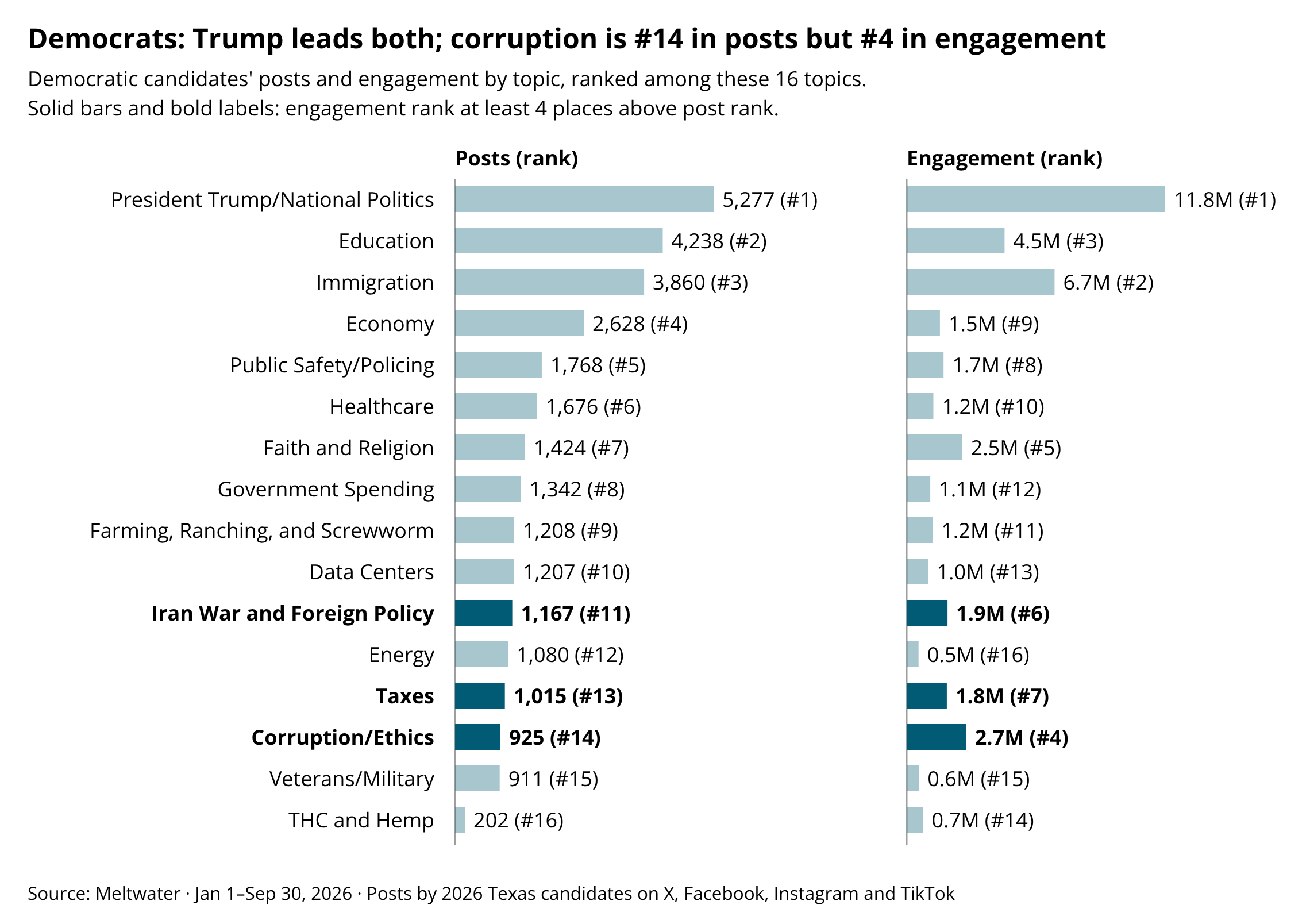
James Talarico led on engagement for seven of the Democrats' top 10 topics. Joaquin Castro led on immigration and the Iran war, and Gina Hinojosa led on taxes.
Democratic leaderboard
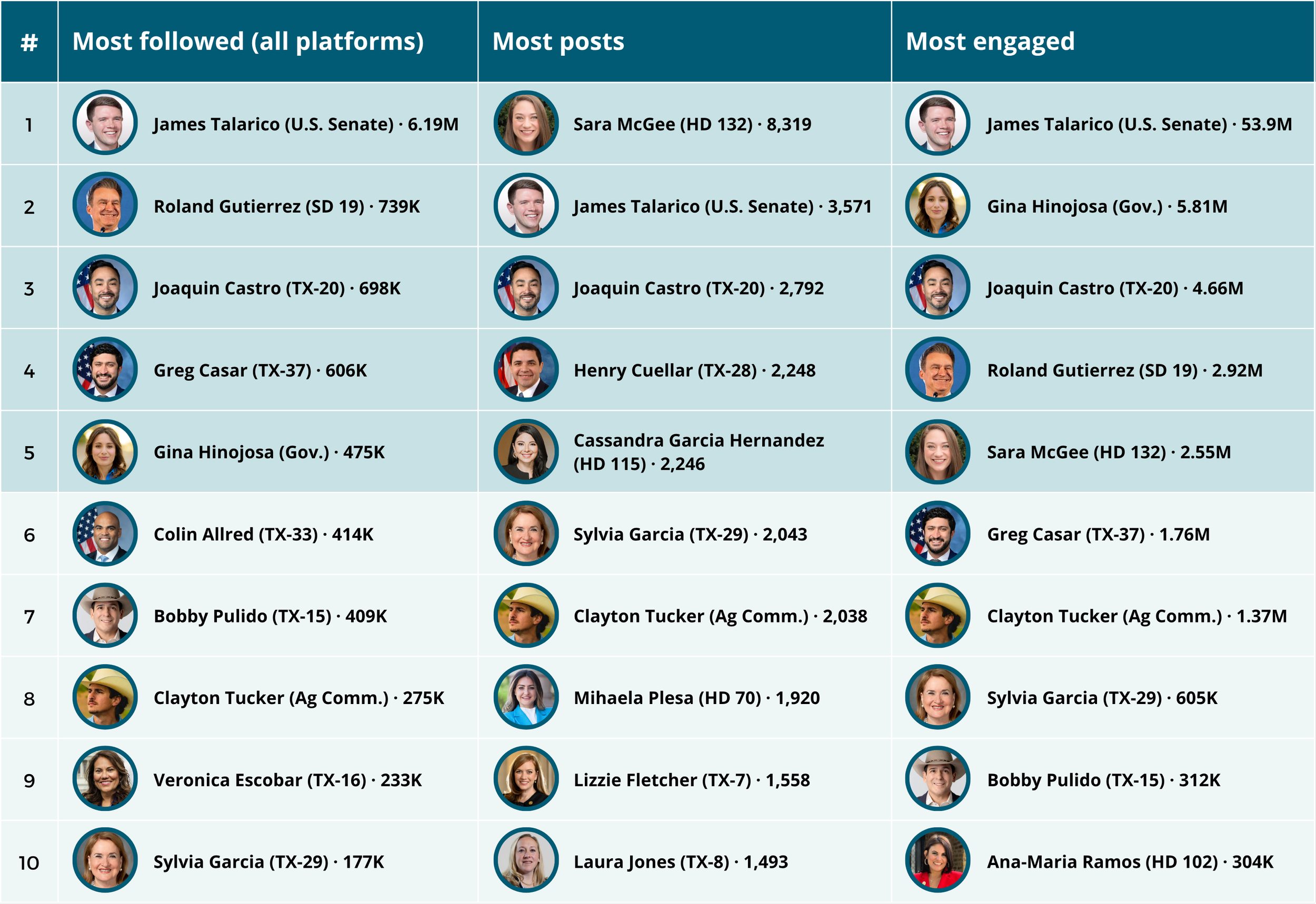
Top Democratic candidate posts by engagement
For Democrats, posts about President Trump led on both measures and represented 15% of all Democratic engagement. Corruption (which led in Texas voter polling as the most important issue facing the country), the Iran war, and taxes saw high engagement relative to volume.