
TxLege Analysis: How the midterms are playing out online
Who posts the most, who gets the most engagement, and which topics do voters respond to.
The lead-up to the 2026 Midterm Election has played out on social media like never before. This time of year, we are surrounded by ads, social media posts, and news stories attempting to introduce voters to candidates. We all see the ads we are targeted by or the posts that our algorithms decide to show us based on our behaviors or geography, but what about the content outside of our individual echo chambers? Being the data nerds that we are, we wanted to quantify the posts from all Texas races to get a full picture leading up to Election Day.
To do this, we analyzed social media posts on X, Facebook, Instagram and TikTok from all candidates from the beginning of the year to the end of September - more than 150k posts! We looked at who is posting most frequently, who’s getting the highest engagement, who has the most followers, which topics users are most likely to engage with, the effectiveness of different channels, and more.
This is Part 1 of 3. Next week we will release Part 2: how the parties differ. Stay tuned for Part 3 the following week: key races to watch.
Key Takeaways
Candidates talk most about Trump, schools, and immigration. All three rank in the top five for both parties, framed in opposite directions.
Two candidates dominate engagement. James Talarico and Brandon Gill earned 62% of all candidate engagement.
Only about 38% of candidates’ posts are about an actual issue. The rest is campaign activity: get-out-the-vote posts, endorsements, events, and holidays.
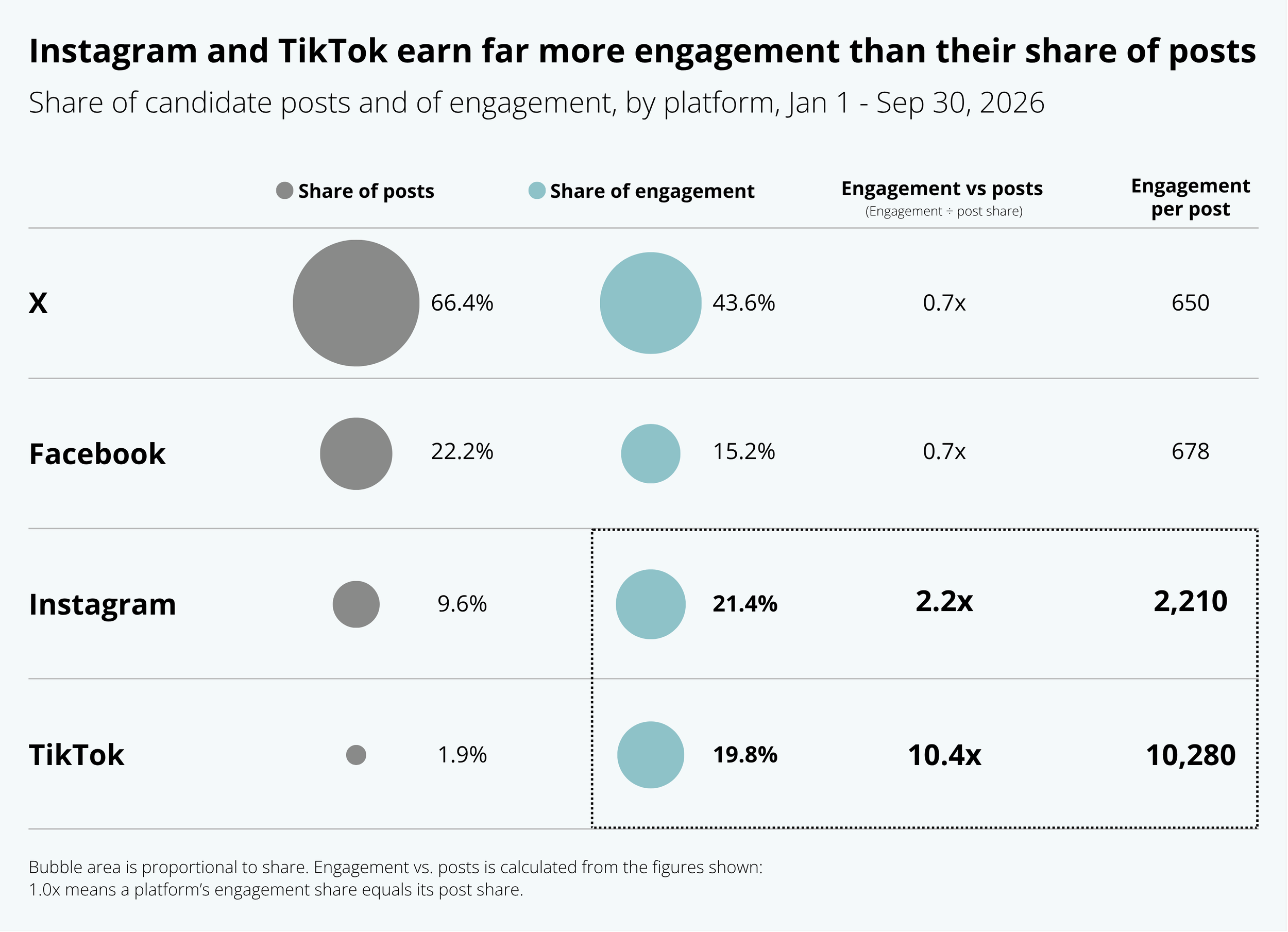
Short-form video wins. TikTok is 2% of candidate posts but 20% of engagement. This content is often repurposed as Instagram Reels, which were the second highest in terms of engagement ratios.
Topics to watch going into the election: AI/data centers, property tax, and Flock cameras/surveillance.
Topics that spiked and faded: the Iran war, the SAVE Act, screwworm, the floods, redistricting, and the THC ban.
-
Data Source: Meltwater
Dates: Jan. 1 – Sept. 30, 2026
Posts: every post, repost and quote post from a candidate’s account on X, Facebook, Instagram or TikTok, including personal, official, and campaign accounts.
Candidates: 2026 candidates for statewide office, U.S. Congress, and the Texas House and Senate (408 tracked; 296 posted)
Engagement:
Facebook: reactions (including likes), comments and shares
Instagram: likes and comments
X: likes, replies, reposts and quote posts
TikTok: likes, comments and shares
Character limit: Our social listening tool captures only the first ~145 characters of each post, and more than half of posts hit that limit. Topics are tagged from that text, anything mentioned later in a long caption, or only in a video or image, is missed.
Reposts: Reposts count toward post totals but carry no engagement of their own. About 30% of candidate posts on X are reposts.
Candidates posted 153,715 times this year
Candidates posted about 560 times a day combined. Volume peaked in the run-up to the March 3 primary, dipped afterward, then rose again, reaching its highest point in September as campaigns kick into overdrive leading up to Election Day.
X still represents the lion’s share of content, with two of every three posts. But the more engaged audiences are elsewhere: an Instagram post earns more than three times the engagement of a post on X, and a TikTok post earns about 16 times as much. While legislators, staffers and reporters still use X regularly, voters are spending more of their time on Instagram and TikTok consuming short-form video. Campaigns that make engaging videos will see the investment pay off.
Candidates Leaderboard
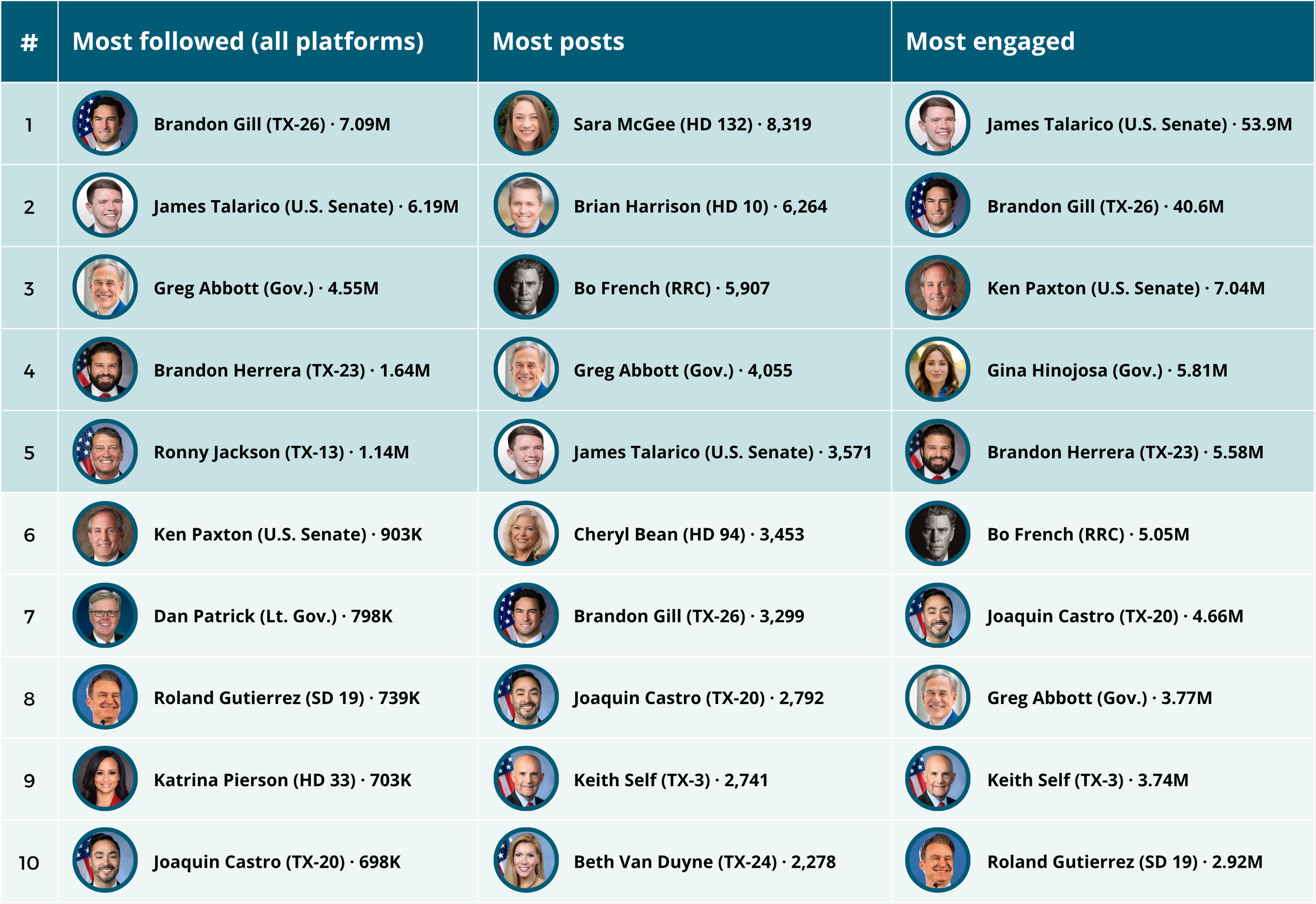
We ranked candidates by followers, posts, and engagement. Four candidates make all three lists: James Talarico, Brandon Gill, Greg Abbott, and Joaquin Castro.
Posting a lot doesn't guarantee engagement: four of the 10 most active candidates aren't in the top 10 for engagement (e.g., Cheryl Bean (HD 94) is #6 in posts but #85 in engagement). A big audience doesn't guarantee it either. Ronny Jackson, Dan Patrick, and Katrina Pierson are top 10 in followers but not engagement, while Gina Hinojosa, Bo French, and Keith Self enjoy higher engagement than much larger accounts.
Talarico and Gill drive the conversation
James Talarico and Brandon Gill earned 94.5M engagements combined, representing 62% of all engagement, and more than twice the next eight candidates combined (38.6M). Both are effectively using short-form video, but are achieving their high engagement through different platforms – Talarico on TikTok and Gill on X.
James Talarico:
TikTok drives his engagement. TikTok videos represent just one-fifth of Talarico’s posts but nearly half his engagement (25.6M). His "My response to President Trump" TikTok is the single most engaged post of the cycle (3.68M), and he has the largest TikTok audience of any candidate (2.0M).
Engagement from his personal and campaign accounts is evenly split. Team Talarico HQ earned 28M engagements, slightly more than his own accounts (26M).
His engagement continues to grow. September was his biggest month: 16.6M engagements, nearly a third of his engagements this year.
Brandon Gill:
Gill’s engagement is driven primarily by clips. Gill’s House hearing exchanges, cut short and posted to his channels, are the most engaged Republican content of the year. His Facebook posts average 21,600 engagements each.
He is a top voice for immigration among Republicans. It's 18% of his posts, and he earns 74% of all Republican engagement on the topic.
He outdraws the top of the ticket. Gill, a U.S. House member, earned nearly six times the engagement of the Republican Senate nominee, Ken Paxton (7.04M), and more than 10 times that of Gov. Greg Abbott (3.77M). His immigration posts alone (7.1M) out-earned everything Paxton posted this year.
Most engaged posts of the year
Trump, schools, and immigration lead the conversation
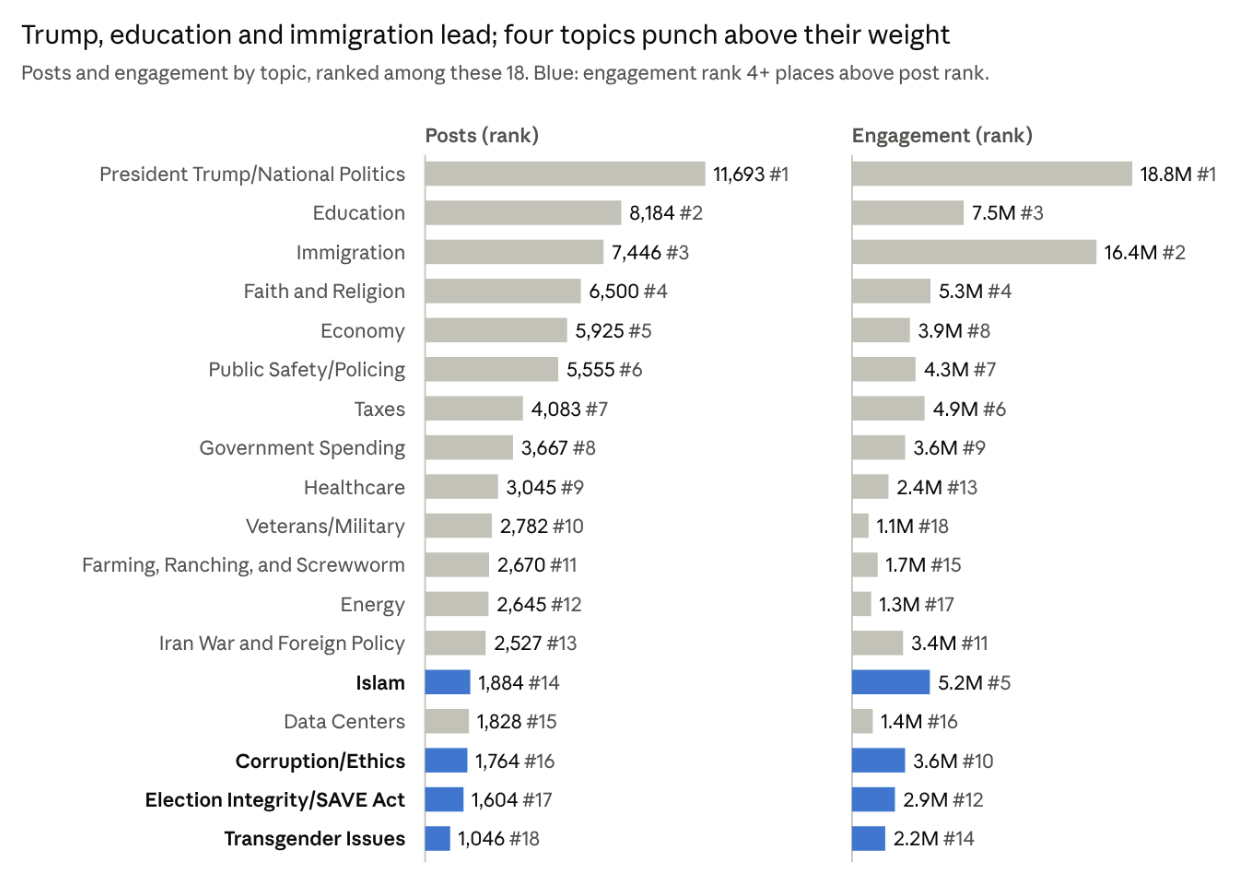
Trump and national politics are the most-discussed topics of the year, followed by public schools and immigration. Together, the four appear in about one in six candidate posts. As we saw above, the number of posts doesn't always line up with engagement. Topics in blue earned high engagement relative to their volume of posts.
Conversation around Islam sees the highest engagement relative to volume: #14 in posts but #5 in engagement, led by Brandon Gill (43% of its engagement), Keith Self (21%), and Bo French (15%).
Corruption, election integrity, and transgender issues also draw more attention than their post counts suggest.
Veterans, energy, and farming see high volume but lower engagement. Many candidates post about them, but those posts draw little engagement.
Hot-button issues drive engagement. The average post about Islam earns about 2,800 engagements, and posts about transgender issues earn about 2,100. The average post about veterans earns about 400 engagements.
Four conversations to watch heading into session
Most of this year's spikes were one-time news events that faded fast (the Iran war and the SAVE Act in March, screwworm in June, the floods in July, and the THC ban in August). Two kept growing: AI and data centers, and property tax. AI and data centers now show up in three times as many candidate posts as they did in the first half of the year, and property tax in more than twice as many. Both are likely to become bill fights in January.
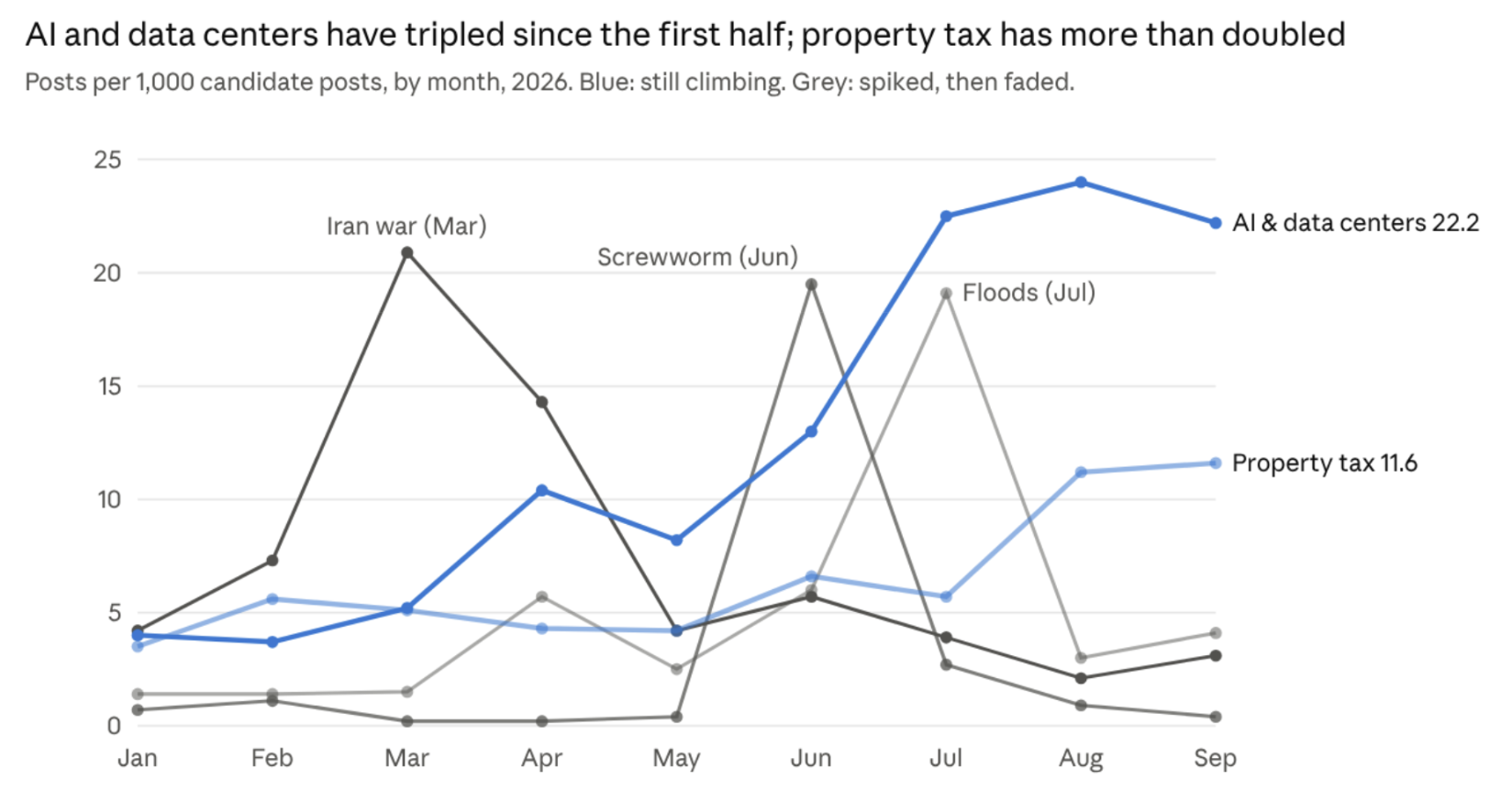
AI & data centers (70% Democrat): Currently about 1 in 45 candidate posts. Abbott paused new data-center grid connections Aug. 3 pending a PUCT/ERCOT review.
Property taxes (83% Republican): Abbott has called for eliminating school property taxes for homeowners.
Flock cameras and surveillance (63% Republican): a rare bipartisan issue, with local camera contracts and privacy bills in play.
Speaker race (89% Republican): who holds the gavel shapes every other fight. Harrison and allies have fought against giving chairmanships to Democrats.